
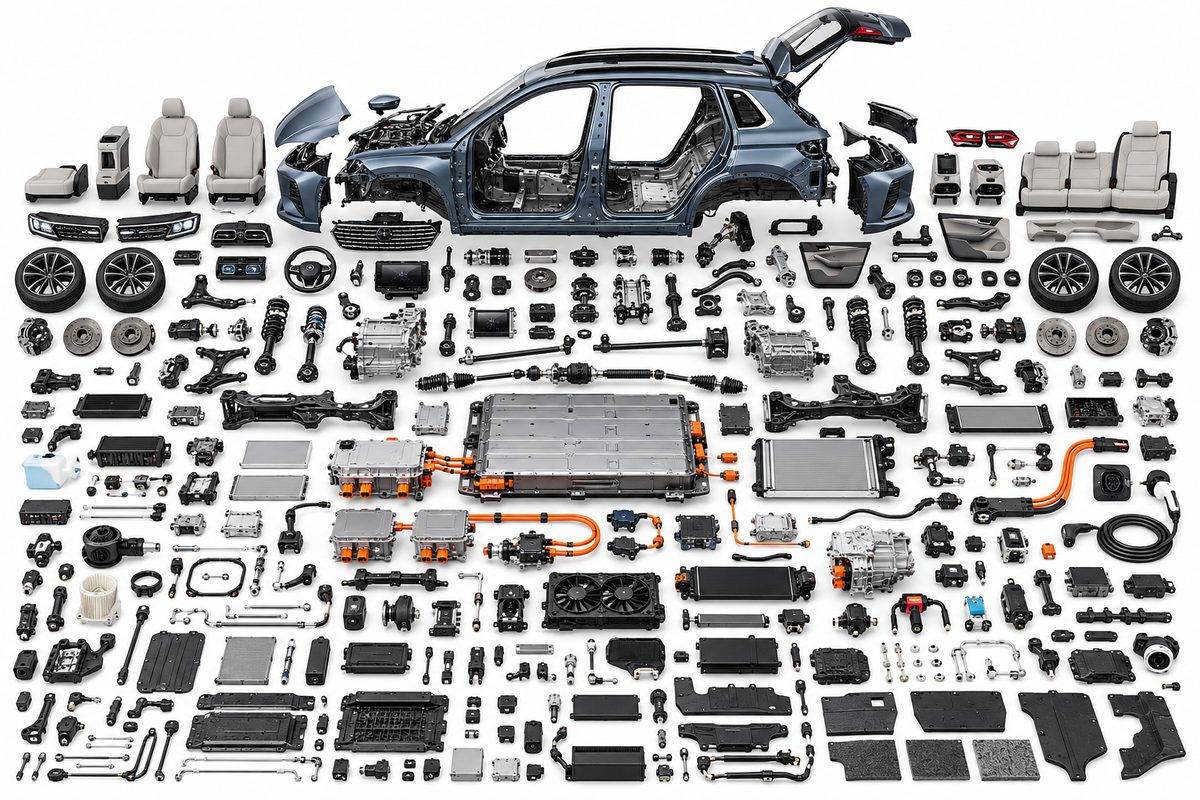
Why the model name is not enough
A replacement component listed for a Chinese domestic-market vehicle may not fit the corresponding export model. Regional safety requirements, powertrain configurations, electronic systems, climate equipment, model year changes, and left-hand-drive or right-hand-drive layouts can affect compatibility.
Buyers should verify the vehicle identification number, original part number, production information, and applicable specifications before placing an order.
Step 1: Identify the vehicle
Collect the following information whenever possible:
- Vehicle brand and model.
- Model year and production date.
- VIN or chassis number.
- Destination market or export version.
- Engine, powertrain, EV, or PHEV configuration.
- Left-hand-drive or right-hand-drive layout.
- Photos of the original component and installation position.
For electric and plug-in hybrid vehicles, additional powertrain and control-system information may be necessary, especially for high-voltage, thermal, charging, or electronic modules.
Step 2: Verify the original part number
The original part number is often the most useful reference for identifying replacement components. However, part numbers may change because of engineering updates, supplier changes, or product revisions.
A reliable process should consider:
- Original part numbers.
- Replacement or superseded part numbers.
- Vehicle production dates.
- Technical documentation and catalog references.
- Component interchangeability between models or versions.
Step 3: Confirm compatibility
Before confirming an order, the proposed component should be checked against the intended vehicle. Depending on the part, compatibility review may include:
Fitment must be confirmed as a set
Check the part against the vehicle's dimensions, connectors, functions, and market specification together. A similar appearance or model name alone is not enough.
For electronic modules and EV-related components, physical compatibility does not necessarily guarantee functional compatibility. Some components may require programming, calibration, or manufacturer-specific procedures after installation.
Step 4: Confirm quality, packaging, and lead time
Once compatibility is established, buyers should confirm product specifications and commercial details before shipment. These may include manufacturer information, quality documentation, product condition, packaging requirements, warranty terms, export restrictions, and estimated lead time.
Completing these checks before shipment helps reduce avoidable procurement risks, repair delays, return costs, and inventory problems.
What to send when requesting a quotation
For a more efficient quotation process, provide a parts list containing vehicle brand, model, model year, original part numbers, quantities, and destination country. VIN information and product photos can help improve identification accuracy.