

Start with centralized parts requirements
Businesses sourcing across several Chinese automotive brands should consolidate requirements into a standardized parts list before requesting quotations. This reduces communication errors and helps suppliers respond more efficiently.
Each RFQ should ideally include:
- Vehicle brand and model.
- Original part number or reference number.
- Product description and photos where available.
- Required quantity.
- Preferred sourcing category, such as OEM, OES, or aftermarket.
- Delivery destination and target schedule.
Evaluate supplier capabilities beyond price
The lowest quotation is not always the best procurement decision. Supplier selection should consider whether the supplier can reliably obtain the required components, support part-number verification, provide appropriate inspection procedures, and communicate realistic lead times.
Consolidate procurement across multiple brands
An overseas distributor may need BYD body components, Jetour suspension parts, Changan electrical components, and Geely maintenance parts in the same purchasing cycle. If each item is handled through a separate supplier, the buyer may face repeated negotiations, payments, shipment arrangements, and quality checks.
A coordinated sourcing approach can simplify supplier communication, consolidate quotations, improve order management, reduce administrative workload, and create opportunities for shipment consolidation.
Establish quality verification procedures
Quality control should be adapted to the product category and purchase requirement. Depending on the component, checks may include supplier qualification, documentation review, sample inspection, dimensional checks, functional testing, packaging inspection, and pre-shipment verification.
For safety-critical or high-value components, appropriate technical testing and compliance documentation are especially important.
Plan international logistics carefully
Automotive spare parts vary in size, weight, handling requirements, and shipping restrictions. Body panels, electronic modules, mechanical components, and lithium batteries may require different logistics arrangements.
| Area | Questions to confirm |
|---|---|
| Packaging | Does the part need protection for surface finish, fragile connectors, or oversized dimensions? |
| Customs | Are customs classifications, import regulations, and product documents clear? |
| Restrictions | Do any parts involve dangerous goods, batteries, liquids, or special handling? |
| Delivery terms | Are insurance, shipping method, handover point, and delivery schedule agreed? |
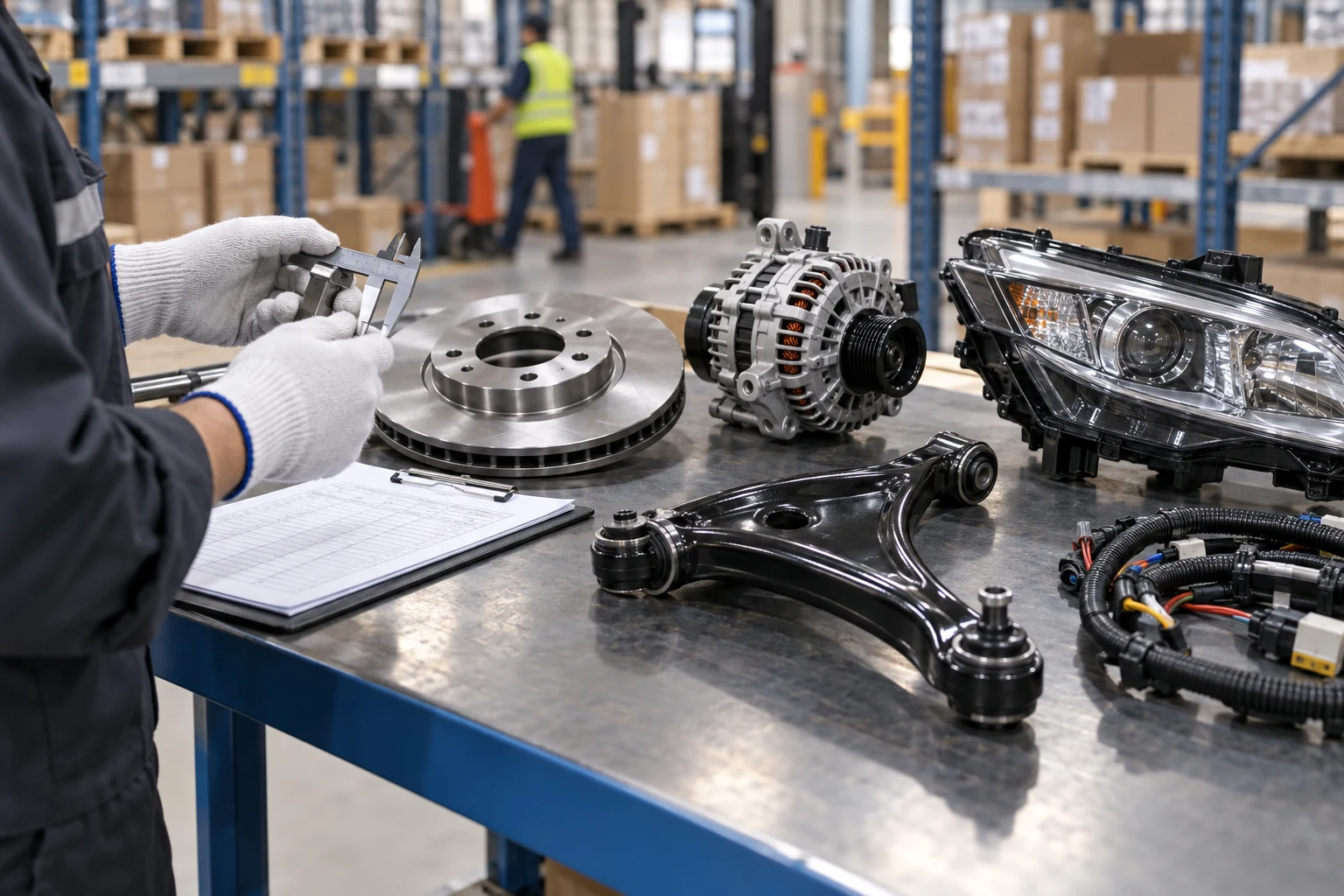
Direct factory sourcing vs. integrated sourcing
Direct factory sourcing can be effective for large-volume purchases of a single standardized product. However, it may be less practical when orders involve multiple brands, diverse product categories, or relatively small quantities.
Integrated sourcing is not automatically better for every case, but it can reduce complexity when a buyer needs supplier coordination, part verification, quality follow-up, packaging alignment, and export logistics across several categories.
How ORIWELL supports global buyers
ORIWELL connects international automotive businesses with China's automotive manufacturing and supply chain resources. The approach is built around coordinated sourcing across brands, product categories, component suppliers, sample follow-up, quality checks, packaging arrangements, and delivery planning.
In addition to automotive spare parts, ORIWELL's broader product portfolio includes automotive protection films and window tint, vehicle accessories and modification products, EV charging equipment, and selected automotive digital solutions.